

How to Create Effective Flash Cards
By: Fred, but mainly Emma :-)

Flashcards are a powerful study tool and a key component of my learning system. They boost retention by leveraging active recall and strengthening memory pathways in your brain.
Creating great flashcards is a personal process that everyone must undertake individually.
It's also a balancing act—too many flashcards, and you won't remember them all; too few, and you might not cover the syllabus. So, how do we start?
⚠️ In my videos, I mention flashcards heavily and provide "minimum suggested flashcards" at the end of each section – take note!
Why don’t I just write them for you?
Well, I could - but when you create your own flashcards, you:
Actively engage with the material
Identify key concepts
Rephrase information in your own words
Strengthen neural connections related to the topic
This process helps solidify your understanding far more effectively than simply reviewing pre-made cards. You will naturally produce a lot of flashcards initially, and that's great. But as the exam date approaches, we need to get razor-focused.
Creating Your Flashcards
It doesn't matter if you manually write them or use an online platform like Brainscape or Anki - just make sure you do them.
Here is an example of what a student might write on their initial flashcard:
Topic: Good Radar Practice-/Limitations of Radar
The quality of the radar's performance needs regular checks: A performance monitor, if fitted, should be used for this purpose.
Misalignment of the heading marker, even slightly, can lead to dangerously misleading interpretations of potential collision situations.
Small vessels, ice, and other floating objects such as containers may not be detected by the radar.
Video processing techniques should be used with care.
Echoes may be obscured by sea or rain clutter.
Masts or other structural features may cause shadow or blind sectors on the display.
Simplifying Complex Information
Next, simplify the complex information into bite-sized pieces. Research suggests we only remember 7 items (plus or minus 2), as illustrated below:

For many (and me) it's closer to 5, so we need to start culling.
How Do We Do This?
Keep it short—focus on keywords rather than lengthy sentences.
Your flashcard should now look something like this:
Topic: Limitations of Radar
Performance, Heading, Ice, Video, Echoes, Masts
Flashcards and Past Papers: A Powerful Duo
Now that we’ve created concise flashcards, let’s discuss how to use them effectively with past papers.
Approximately 2 weeks before your exam, my online program will instruct you to request past papers.
Flashcards go hand in hand with past papers. Start practising (with your now reduced flashcards) how to answer exam questions—in webinars, small group sessions, and with study buddies. Answering real exam questions is very different from just reciting flashcard answers. This process helps you apply your knowledge in exam-like conditions, improving your recall and performance under pressure.
Deepening Your Preparation
Perform a risk assessment of past papers—Technical Analysis 101!
(You will find a detailed video after the LSA section within my online course.)
Time is limited, and the syllabus is vast, so focus and efficiency are key. Assess the likelihood and severity of the topics most likely to appear in your exam.
Use your time wisely and avoid bias. We tend to gravitate towards the easier questions. As you work through past papers, record the likelihood of each topic appearing in the exam.
Example Tally:
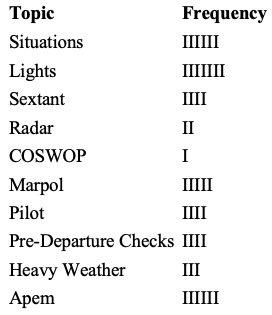
Allocate Your Study Time:
Create piles of flashcards descending from high to low importance. I usually suggest three categories: Critical, likely and Meh. Although I would like all your answers to be perfect, I am a realist, so practice answering past papers with your reduced flashcards, ensuring:
"Critical" is perfect
"likely" is near-perfect
"Meh" is ok
Key Takeaways
1. Creating flashcards is as valuable as reviewing them.
2. Keep your flashcards concise and focused.
3. Use flashcards in conjunction with past papers for optimal preparation.
4. Prioritise your study time based on the likelihood of topics appearing in your exam.
Your Turn!
Now that you've learnt these strategies, it's time to create your own flashcards. We'd love to hear your experiences! Share your own flashcard creation tips or join our study group to discuss more study strategies.
