

How we learn: what the experts say

You might not listen to me, but hopefully you will listen to the experts!
Scientific evidence on how we learn
Now I am the first person to put my hand up if I can find an easier and faster way to get a job done (efficient or lazy? Eh, probably a bit of both), so before I began my own study quest for the creation of my Master app, I decided it was time I brushed up on some of the things I learned during my psychology degree. Plus I’ve always been fascinated with how we actually learn.
So I read/watched…
‘How we learn – the surprising truth about when, where and why it happens’
How to ‘Make it stick – the science of successful learning’
How to ‘Outsmart your exams’
‘Atomic Habits - An easy & proven way to build good habits and break bad ones’
Various Ted talks and other articles
I won’t go into too much detail, but I wanted to bring your attention to some key points.
Fluency Illusion
Firstly, be aware of Fluency illusion, as I have seen this first hand.
Basically, this means you think you know a topic, –but you don’t. Or you forget many of the details about the topic, but you don't know/realise you’ve forgotten them.
“The fluency illusion is so strong that, once we feel we’ve nailed some topic, we assume that further study won’t help. We forget that we forget.”
How do you combat (fix) this?
You need to test yourself. Do quizzes, use flashcards, talk out loud to your Mum, boyfriend or girlfriend, dog, etc. Try to find a study buddy and keep testing yourself.
Spaced Learning
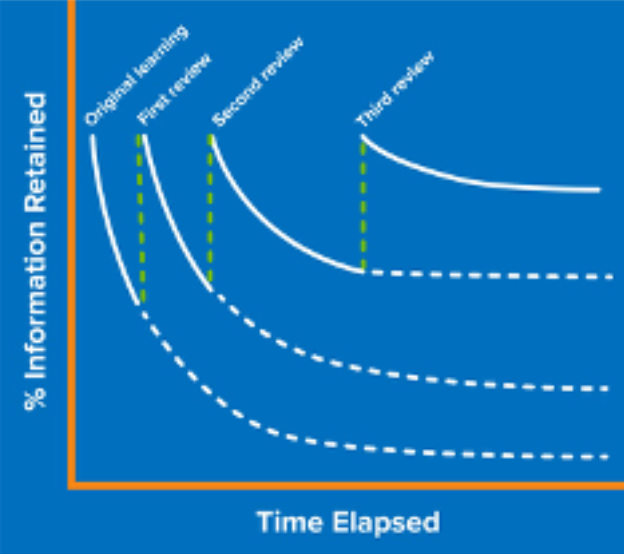
The most important discovery Ebbinghaus made was by reviewing new information at key moments on the forgetting curve, you can reduce the rate at which you forget.
Basically, short reviews help and forgetting can be a good thing.
Even though our memory fades quickly, a review session soon after the original learning can improve it. This session should happen when recall has slipped significantly, but hasn’t fallen so low that you’re essentially starting over.
The gaps between your review sessions can be longer as time goes on. So, you might refresh your learning from a lecture the following day, then two days later, then after a week etc.
Reviewing information like this at strategic points after learning will stretch your recall. You will also discover any gaps that you need to focus on.
A great flashcard app that uses spaced learning is Brainscape or ANKI.
Watch this med student explaining how to use it on video. He talks fast, but he has good tips!
Reading vs Reciting (& which one wins)
“the best results are obtained by introducing recitation after devoting about 40% of the time to reading.”
Hence why I want you to speak out loud! And come to my webinars!
Interleaving of different topics
Interleaving is a learning technique that involves mixing different topics to facilitate learning. For example, when revisiting don't just do sextant and test yourself, then move on to radar and test yourself; do a question here and there and mix it up!
In my quiz app, you can do this. You can still be quizzed per subject, or in the "final quiz," it keeps asking random questions from each topic to keep you on your toes! It's checking to make sure you don't have "fluency illusion.” 😉
Take time to process the information / Study breaks.
Go for a walk/run/have a bath etc. – turn off for a bit – you need to unconsciously process the information.
One of the reasons I changed my immersive 1-week oral prep to two weeks in the old days.
Sleep
I won’t go into too much detail here because we all know this but it’s SO important so we cannot skip it. It’s important not only to help you absorb what you study, but also to let your brain process and retain it.
Here’s me giving you permission to not feel guilty for having a little afternoon nap.
If you ever have time (but not now if you're currently studying!), read "Why we sleep: The new science of sleep and dreams.” It might depress you to know how many sleepless nights you had on charter and the damage it’s doing.
Embrace difficulties
“Trying to solve a problem before being taught the solution leads to better learning.”
*This is the linked video resource mentioned in the Mind Mapping section of this post; we are not affiliated with this YouTube channel & do not claim ownership of this video or its content.
Mind Mapping (a personal favourite)
This YouTube video explains it better than I can.
Also, there are some great Ted talks on Memory.
Hopefully, you find a technique that can help you!
